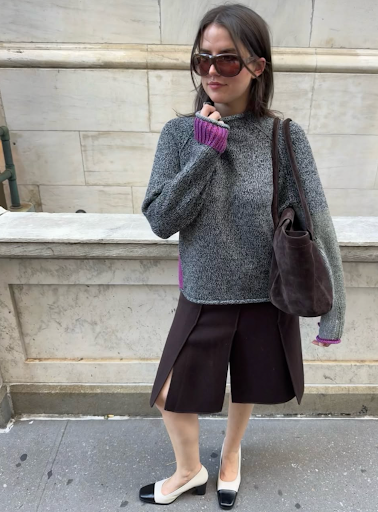

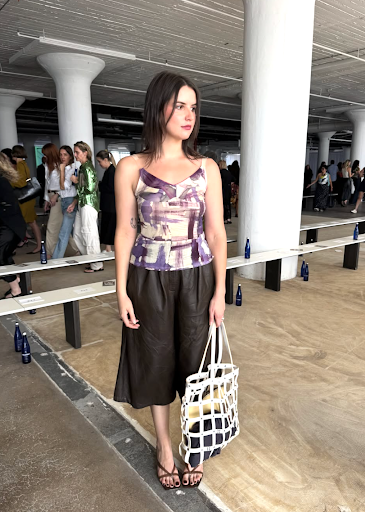
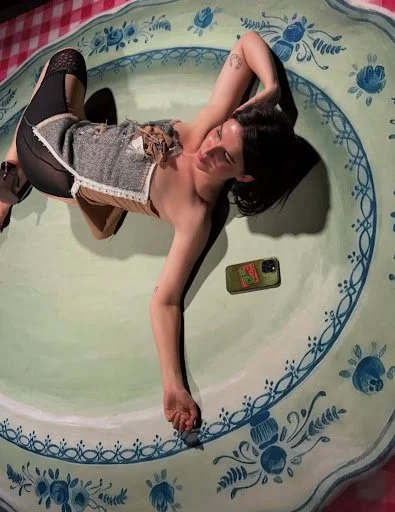
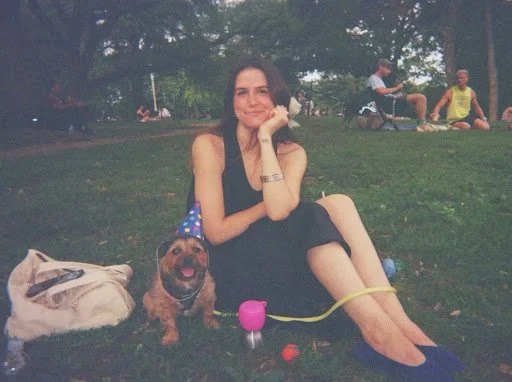
For fashion creator Heather Hurst, or @pigg.jpeg @pigmami, getting dressed is about much more than just putting together an outfit. Heather has built an internet persona off of her eclectic wardrobe, meticulously sourced secondhand pieces, thoughtful approach to fashion, and adorable dog, Pig.
Originally from the Washington, D.C. area, Heather studied Kinesiology at university and worked in public health before moving to full-time content creation. She began posting on social media in her mid-twenties and wanted to develop a wardrobe that felt representative of who she was becoming. Heather is now based in New York City, where she continues to document and explore her love of vintage clothing, emerging brands, and the stories behind her wardrobe.
At a time when social media presents a new trend daily—introducing something we ‘must’ acquire—Heather presents a rather refreshing philosophy. Instead of viewing personal style as something perfect or innate in us, she sees it as something that takes time to develop and grows with us through different phases of life.
I had the privilege of speaking with Heather about what influences her wardrobe, how to navigate trends, and why finding your personal style might actually require less time than thinking about fashion.
How would you describe your personal style in a few words?
Heather: “Eclectic, intentional, comfortable, and feminine.”
For Heather, comfort and individuality are not mutually exclusive. Long skirts, dresses, high heels, and embellished clothing are staples in her wardrobe. Not necessarily because they belong to a specific aesthetic, but because she genuinely enjoys wearing them.
She also explains how her approach to getting dressed has changed as she got older. She once cared deeply about receiving compliments, but now she dresses for herself.
“When I was little, I thought that I wanted to serve so badly,” she recalled. Today she is much less interested in receiving attention from her outfits and prefers to connect with people through their shared love and appreciation of clothing.
With trends constantly changing on the internet, how can people develop and understand their own personal style?
Heather: “I like to think of things as different eras. And sometimes you have seasons of working really hard on your style. And sometimes you have seasons of just not thinking about it too much.”
Heather recalled that much of her early 20s involved searching for perfect basics, almost creating a checklist for personal style. However, over time, she discovered that constantly searching for new clothing wasn’t helping her discover her personal style or what she actually liked.
Instead, she distanced herself from the internet and began experimenting with clothing she already owned.
“If you just let it sit, it will reveal itself to you,” Heather said.
Her philosophy is particularly refreshing in an online era where developing personal style might feel like a task to complete. Rather than rushing to fit into an aesthetic, Heather encourages taste to reveal itself over time and experiences.
How can someone tell if a trend is for them or if they are being influenced?
Heather: “I always try to think about: where did I see this trend? What was the idea that made me want to partake in this?”
Heather explained how it is easy to fall in love with an item or a trend because of the person wearing it. Perhaps what makes an outfit appealing is the setting, person, or lifestyle associated with it.
Her advice is to imagine the outfit or trend outside of the carefully styled photo or video. She asks herself, “Would I still be excited to put it on during an ordinary morning?”
Heather also recommends taking time with an item before deciding to keep it or buy it. Take photos, try things on, wait a few days. If the initial excitement fades, it is often easier to determine if we like something.
She also adds that while experimenting is good, you don’t need to “ buy a problem” by investing in a style or cut that you know does not work for you.
Who or what has influenced your personal style the most?
Heather: “Vivienne Westwood, historically, and Marc Jacobs were definitely big influences when I was younger.”
She also mentioned Tory Burch, who she has admired since she was a child, and Mary Quant, whose designs reflect Heather’s appreciation for 60s fashion.
She recalled that her inspiration goes far beyond designers. Growing up, she was incredibly inspired by musicians, books, films, and television characters. She remembers cutting out images from Teen Vogue magazines and pasting them in her bedroom.
Today, she is inspired by influencers whose style differs from her own.
“I like having access to subcultures and lifestyles that I don't know anything about,” she said. Eugenia McQuarrie, Rian Phin, Toni Munton, Lara Violetta, and Invisible Stories are among some names that she lists.
Instead of following creators to copy their outfits and aesthetics, she enjoys looking to them for new perspectives. She explains that inspiration does not require buying something.
If you had to rebuild your wardrobe from scratch, what would be the first pieces you would repurchase?
Heather: “Probably a pair of Tory Burch ballet flats.”
She also mentions a Galliano dress that transitions perfectly from day to night, her favorite Vivienne Tam skirt with a dragon on it, and a simple three-quarter sleeve top.
Her choices reflect the balance between practicality and individuality that characterizes her style. While Heather is drawn to embellished statement pieces, she also prioritizes clothing she can comfortably wear throughout the day.
You frequently share vintage and secondhand finds from eBay and Poshmark. What advice would you give readers looking for elevated basics?
Heather: “I think it really helps to look at descriptions of new things.”
Rather than only searching for brands or reverse Google image searching, Heather suggests researching how retailers describe their clothing.
For example, if she finds a designer leather skirt that she likes, she might search secondhand sites with the same descriptive words to find a vintage alternative.
Heather also emphasizes the importance of knowing your measurements, especially when shopping for secondhand vintage designs.
“I always like to measure things that I already own that fit me really well,” she explained.
Another important part of her fashion methodology is tailoring. She emphasizes the sustainability of altering your clothes to fit you rather than continuously searching for a perfect fit.
Heather’s secondhand shopping method is about patience and understanding what works for her just as much as it’s about finding a good deal.
Walk me through how you choose an outfit on an ordinary day.
Heather: “In the mornings, it’s just a vibe-based operation.”
Despite her carefully considered approach to fashion, Heather admits that she is far less organized when it comes to getting dressed in the morning.
She has a folding screen in her apartment where she hangs clothes that she is excited to wear during the week. Rather than planning an entire outfit each day, she uses these pieces as inspiration and starting points. She often considers the weather, her errands, and how she is feeling that day.
Oftentimes, her inspiration comes from something quite simple. She recounts that she recently fastened a Tory Burch earring to the strap of her dress, using it as a brooch.
She also doesn't believe that personal style requires a perfect outfit each day. “I think a lot of people assume that discovering your style means that every day is novel. Every day is a perfect outfit.”
Instead, Heather embraces outfit repeating, experimenting with the same pieces, and making small adjustments.
What are your thoughts on the growing influence of artificial intelligence in fashion? How can personal style be preserved?
As artificial intelligence becomes more integrated into the fashion industry, from generating designs to providing shopping advice, it raises the question of the role of human creativity in its relation to personal style.
Heather: “I feel like part of the heartbeat of fashion is creativity and connecting to things that people have chosen to make.”
Heather acknowledges that AI can serve practical purposes in fashion, particularly in resale and wardrobe-organizing platforms. However, she is skeptical about its role in the creative process.
“I just think knowing that something was made by a person is so meaningful,” she explained.
To Heather, an important part of fashion is the process of creating something, making mistakes, and creating something individual. While AI can offer an easier alternative to this process, she questions if it takes away the thing that makes it worthwhile.
When asked about how people can preserve their individuality in an era where technology is becoming more integrated into fashion, her response was surprisingly straightforward: allow yourself to make mistakes.
“I think the cost of doing things yourself is inefficiency, mistakes, things are ugly, the fear of being wrong,” Heather adds.
Heather argues that personal style is not something that has to be perfect or exactly polished; rather, it is developed through wearing clothing, trying new things, and occasionally realizing that sometimes something just doesn’t work.
“I know what I like because I’ve tried things,” she exclaimed.
Perhaps that is the most important takeaway from my conversation with Heather. In an industry that is constantly pumping new trends and clothing for us to consume, Heather’s ethos is a reminder that we do not always need to focus on what’s next. Perhaps the most interesting and unique thing you can wear is something that you already own and love.